



Building “Director Power” with BDTI
Our Mission
“Provide effective training programs for all directors, both internally and externally, to acquire knowledge, skills, and mindsets related to governance, and contribute to strengthening corporate competitiveness, sustainability, and the development and evolution of the Japanese economy.” This is the mission of BDTI. We will continue to enhance the effectiveness of our courses by reflecting new societal demands and guiding more than 4,500 directors, director candidates, and those aspiring for better governance, careers through executive training.
Our History
The Board Director Training Institute of Japan (BDTI) was established in 2009. Founder and Director, Nicholas Benes, advocated the introduction of the Corporate Governance Code (CGC) in 2013. Since its establishment, BDTI has been working with the mission of contributing to the sound and sustainable development of companies and the economy by improving the corporate governance of Japan companies, and this philosophy is deeply in line with the basic spirit of CGC.
Many top leaders, both in Japan and overseas, agree with the purpose of BDTI and support us in a variety of ways as advisors, collaborators, and donors.
Many top leaders, both in Japan and overseas, agree with the purpose of BDTI and support us in a variety of ways as advisors, collaborators, and donors.
My Thoughts on Corporate Governance
Yasuo Takeuchi, Former Representative Executive Officer, CEO and Chairman of Olympus Corporation

Yasuo Takeuchi joined Olympus in 1980. After extensive overseas experience, he helped rebuild the company following its accounting scandal. As CEO from 2019, he advanced governance reforms, including the transition to a three-committee structure, and focused the business on MedTech. He resumed CEO duties in 2024 and retired in March 2026.
It was not until the introduction of Japan’s Corporate Governance Code in 2015 that the need for and importance of corporate governance began to be widely recognized in Japan. That was only eleven years ago. Of course, this does not mean that corporate leaders before then simply ignored governance. Rather, their understanding and practice of governance were largely shaped by their own experience and judgment. The introduction of the Corporate Governance Code provided a framework that enabled companies to understand, implement, and review governance in a more systematic way. Since then, I believe we have increasingly come across the phrase “governance is not functioning effectively.”
BDTI Board Members’ Roundtable Discussion
Discussing the Revised Corporate Governance Code

Nishida: The revised Corporate Governance Code is now in effect. Today, we’d like to discuss the revised Code and have a conversation that conveys BDTI’s message to those currently serving as directors and officers, those who may take on these roles in the future, and those involved in supporting the board as part of the board secretariat.
In the first half, we’ll cover five themes: (1) the role of directors, including the shift from advising management to overseeing it; (2) the role of the corporate secretary; (3) the “comply or explain” approach; (4) director and executive training; and (5) setting the direction of corporate strategy, along with growth investment and capital allocation.
After that, we’d also like to discuss what the key focus should be for the various stakeholders in light of the revised Code, as well as what we would like to see in the next revision.
Ichikawa: First of all, I think we need to go back to the fundamentals: governance is not about “governance for the sake of governance.” The point is to use governance to enhance corporate value. With ROE continuing to struggle, I think we first need to recognize that there is a growing need to improve the effectiveness of the Code itself.
Activity
BDTI’s activities are organized around three main pillars:
1.Training Courses
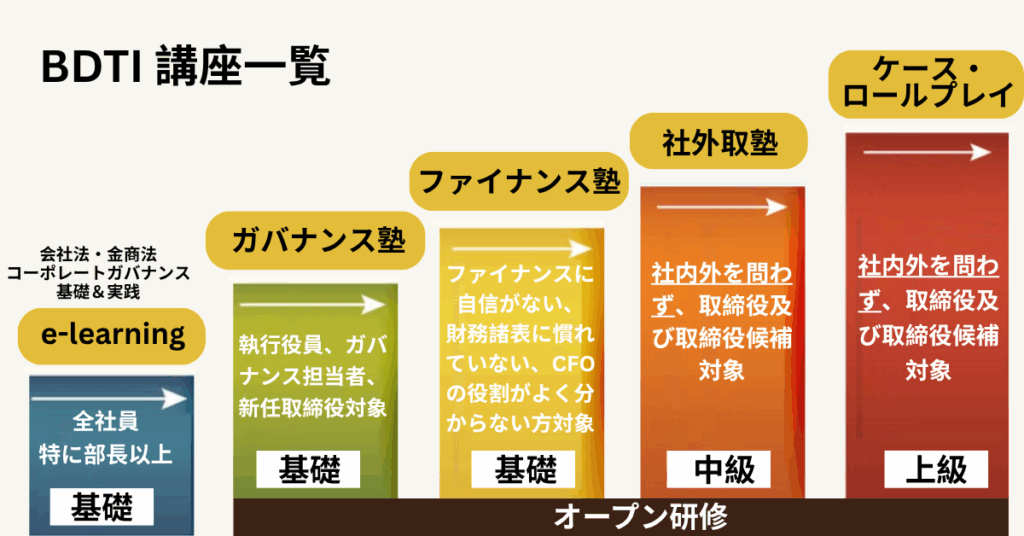
Building on the “Governance Juku,” which is held roughly once a month, we offer Finance Seminars, Outside Director Training, and a Role-Play Course to strengthen the executive competencies that directors should possess.
2.e-Learning (Japanese Only)
Systematically acquire basic knowledge and a mindset regarding governance and corporate management through online courses that can be taken anytime, anywhere
3.Corporate Training
We support the strengthening of corporate governance and the improvement of executive skills through customized training programs designed to address the specific challenges of individual companies (or corporate groups) and tailored to the target audience.
Board of Directors
The members have been leading the development of corporate governance in Japan through their deep involvement in the formulation of the Corporate Governance Code or as members of the FSA’s “Study Group on Corporate Governance Systems”, where they were involved in the design of the system. The members include outside directors and corporate auditors of listed companies, institutional investors, university professors and human resource development consultants, and have deep knowledge in both theory and practice. For biographies, please refer to the following pages.
Our Supporters
Individuals, institutional investors, and organizations who have donated and supported the Board of Directors deeply agree with the Organization’s philosophy and purpose, which is to contribute to the strengthening of the competitiveness of Japan companies and the development of the Japan economy by improving the quality of decision-making at the Board of Directors and realizing sound and sustainable corporate governance.
We would like to express our heartfelt gratitude for your exceptional support.